

ALOHA: Low-Cost Bimanual Teleoperation Dataset
ALOHA bimanual teleoperation datasets: 50+ demos per fine-grained task, open hardware reference. Train ACT/Diffusion Policy in 30 minutes — download now.
The open-hardware bimanual teleoperation platform and canonical imitation learning dataset behind Action Chunking with Transformers (ACT), Mobile ALOHA, and RT-ALOHA.
TL;DR
| Metric | Value |
|---|---|
| Task count | ~10 canonical fine-manipulation tasks (plus dozens of LeRobot re-collections) |
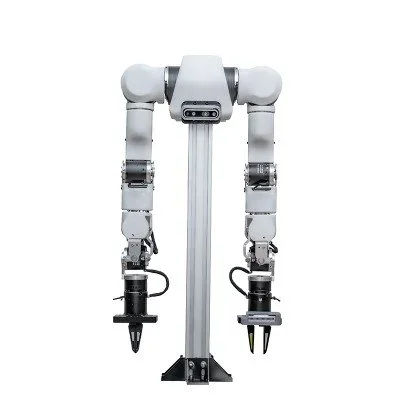
| Robots | 2 ViperX-300 follower arms + 2 WidowX leader arms (6-DoF each) |
| Modalities | 14-DoF joint positions, 2x gripper widths, 4x RGB cameras at 50 Hz |
| License | MIT |
| Size | ~50 demos per task, ~5-15 GB per task package |
| Hardware cost | ~$20K to build a full ALOHA cell |
What is ALOHA?
ALOHA (A Low-cost Open-source Hardware System for Bimanual Teleoperation) was introduced by Tony Zhao and collaborators at Stanford as the accompanying rig and dataset for the Action Chunking with Transformers (ACT) paper. Its innovation was simple but decisive for the imitation learning community: by pairing two 6-DoF ViperX-300 follower arms with two WidowX leader arms, ALOHA made it possible for a single human operator to teleoperate bimanual fine manipulation at 50 Hz with natural posture. That design choice unlocked a new class of tasks — threading zip ties, opening condiment cups, slotting batteries, pouring a packet of sugar into coffee — that single-arm teleop rigs cannot execute repeatably.
The released data packs typically contain 50 demonstrations per task with synchronized joint states, gripper widths, and four RGB camera streams (top, left wrist, right wrist, and external). The HDF5 layout has become a de-facto schema for bimanual imitation learning, and the LeRobot project maintains Parquet mirrors that plug directly into Hugging Face's streaming dataloader.
ALOHA begat the entire Mobile ALOHA, ALOHA Unleashed, and ALOHA 2 line of datasets, and it is the reference platform for Physical Intelligence's π0 fine-tune recipes and Google's RT-ALOHA and ALOHA-Cosmos-Policy releases. Any paper that claims state-of-the-art on "fine bimanual manipulation" almost always reports on an ALOHA-format task.
How to download & load
# Reference hardware / firmware / data
git clone https://github.com/tonyzhaozh/aloha.git
cd aloha && pip install -r requirements.txt

# Download ALOHA static tasks via LeRobot
pip install lerobot
python -c "
from lerobot.common.datasets.lerobot_dataset import LeRobotDataset
d = LeRobotDataset('lerobot/aloha_static_coffee')
print(d[0]['observation.images.top'].shape, d[0]['action'].shape)"
For training ACT or Diffusion Policy on ALOHA data, the canonical entrypoint is act/imitate_episodes.py in the ACT repository, which reads HDF5 directly. For VLA fine-tuning, converting to RLDS via the LeRobot tooling is the path of least resistance.
Common use cases & pairings
- ACT and Diffusion Policy baselines. The 50-demo-per-task regime is the original home of action chunking; ALOHA is almost always the first benchmark for a new bimanual policy architecture.
- VLA fine-tuning. π0, OpenVLA, and RT-2 all have public ALOHA fine-tune recipes. It is the fastest way to ship a bimanual VLA demo.
- Open hardware reproduction. The rig bill of materials and CAD are open, so labs commonly buy the parts, reproduce the exact rig, and then contribute back task collections.
- Mobile manipulation. Mobile ALOHA adds a wheeled base; the datasets are format-compatible and let you study whole-body coordination.
Benchmarks & leaderboards
There is no single leaderboard because ALOHA is a platform rather than a fixed suite — each task is scored on its own success rate. See Papers with Code ALOHA entries and the official project page for headline results per task and canonical hardware references.